ISW at EXPERIMENT 26.2: drones, radars and sensors connected to BC2A® in a common operational picture
At the exercise organized by the Romanian Land Forces Staff at the Prislop training area, ISW connected the blue-force battalion's smart systems to the BC2A® command and control platform in about three weeks.
ISW (Interactive Software) took part in the integrated exercise EXPERIMENT 26.2, organized by the Romanian Land Forces Staff (SMFT) from 26 to 30 October 2026 at the Prislop training area in Argeș County. Together with 26 other companies, we worked alongside military personnel to test whether drones, ISR systems, and weapon systems could exchange data with command and control systems in a scenario set in the training area’s mountainous, forested terrain.
From sensors to the command post map
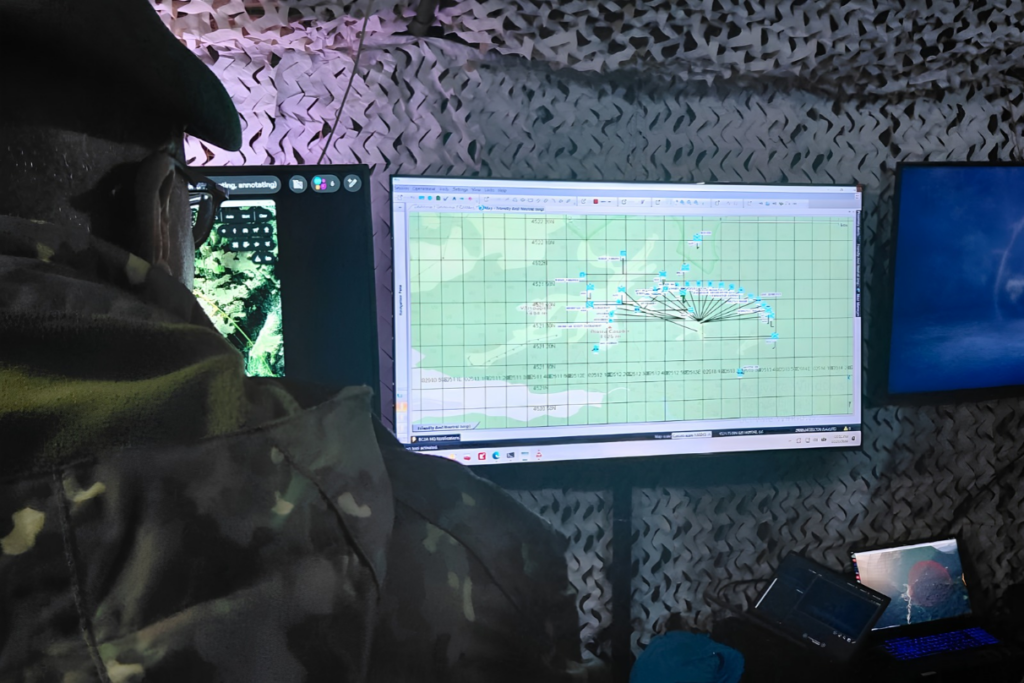
ISW integrated the systems with the BC2A® platform used at the blue-force battalion command post. In about three weeks, our team connected to BC2A® all the smart systems that the participating companies provided to the battalion:
- air surveillance radars;
- surveillance and strike drones;
- presence and surveillance sensor systems for perimeter protection.
BC2A® received the position and status of each system, sensor alerts, and data on detected targets, including three-dimensional positions of aerial targets. Staff officers could analyze and correlate the information, and mark each element on the map as friendly, hostile, neutral, or unknown. From the application, they could access a drone’s video feed in near real time and send it commands. Based on this data, commanders decided whether to keep a target under surveillance, jam it, or neutralize it.
The aim was to give the battalion staff and subordinate echelons “a common operational picture as close to reality as possible”.
NATO standards accelerate integration
Many of the systems at Prislop had data exchange interfaces based on NATO standards. For these, the technical integration effort was minimal. For the other systems, we agreed with the manufacturers on the messages to be exchanged and exchanged interface specifications.
The result is an integration demonstrator. Turning it into an operational system requires requirements defined with the customer and a test-and-evaluation plan with measurable results, carried out with the end user.
Why field testing matters
The exercise allowed us to test and optimize VISAN (Visual Intelligence for Safe Autonomous Navigation) in real conditions. VISAN is ISW’s AI-based solution that enables drones to navigate without a GPS signal. Until now, its AI models had been trained only on mountainous terrain in simulated conditions.
Prislop confirmed how important it is for the defense industry to have access to military training areas. Laboratory tests cannot fully reproduce field conditions, including the effects of electronic warfare.
A capability is more than technology
Technical integration must be accompanied by a concept of operations, rules of use (including legal ones), updated procedures, and training programs for operators and staff personnel. After the exercise, the SMFT leadership expressed interest in continuing the dialogue with industry on these topics in Bucharest.
Statements
“What we achieved in these weeks is an integration demonstrator, a proof of concept.”
“A capability means functional systems, trained personnel and operating procedures. Only when all these components work together can we speak of a capability.”
— Marian Ivănescu, General Manager and co-founder, ISW
Read the full article on DefenseRomania: Armata română testează noile tehnologii: Drone și radare, într-o imagine operațională comună la poligonul Prislop